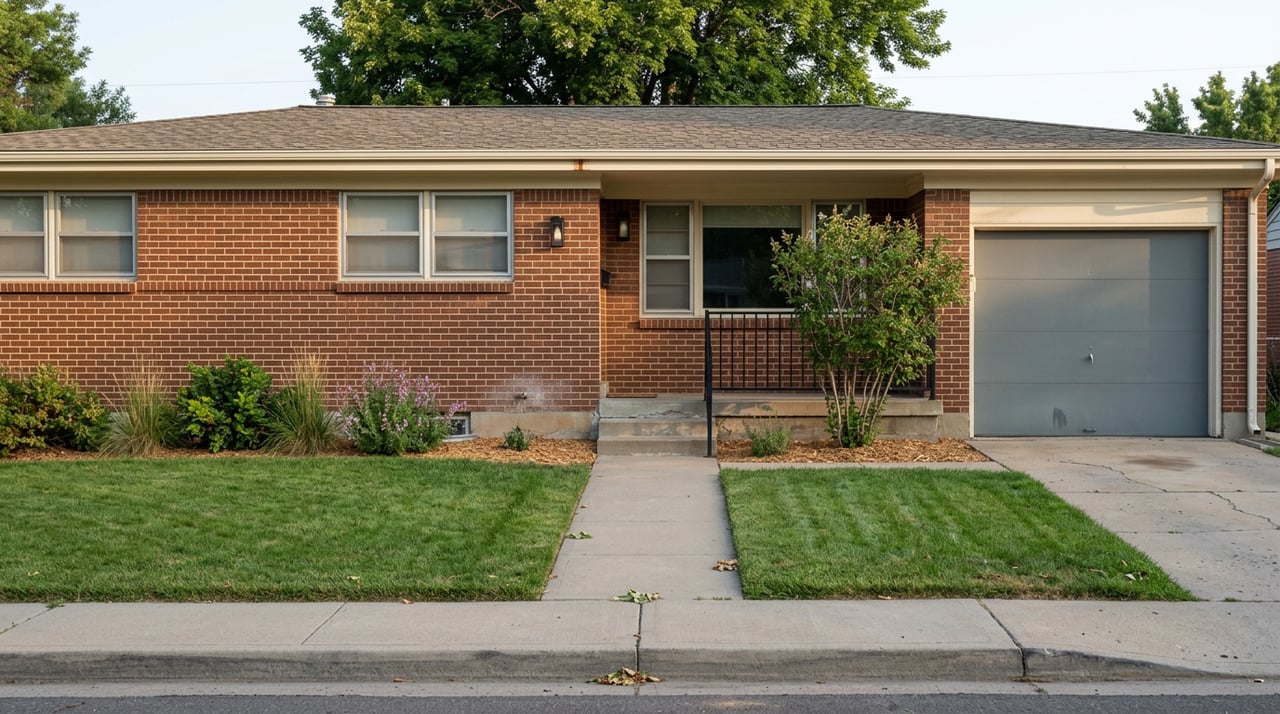
At 3004 S. Imperial St in Millcreek's Mountair Acres subdivision sits a brick rambler built in 1959, the lone true Ranch-style home in a neighborhood built almost entirely from the same postwar playbook, according to a detailed architectural survey of the area by local historian Jacob Barlow. Of the subdivision's primary buildings, 348, or 93 percent, are brick. Most run 600 to 800 square feet on the main level, a size set by the FHA's "minimum house" standards from the mid-1930s National Housing Act. Walk that block, or dozens like it across Millcreek, and you are looking at homes built to the same code, in the same decade, by builders working from the same narrow set of assumptions about what a postwar family needed.
None of those builders assumed that someone in 2026 would need to know what's happening sixty feet under the driveway.
That's the actual subject here. Not the granite. Not the finished basement. The pipe.
The Boom That Built Millcreek's Bones
Millcreek didn't become a city until December 28, 2016, at 9:30 in the morning, according to the city's own history page. But the neighborhoods themselves are much older than the city that now governs them. Suburban growth expanded through Millcreek from the mid-1930s into the 1960s, and veterans returning from World War II and the Korean War were among the first buyers in what became Canyon Rim and Olympus Cove. Everything built since has mostly been infill, smaller subdivisions tucked into a street grid that was already set decades ago.
That timeline matters more than it sounds like it should, because it means Millcreek's housing stock isn't a mix of eras so much as a concentration of one. A large share of the city's homes, particularly in the dense core around ZIP codes 84106 and 84107 and in the Canyon Rim and East Millcreek pockets, were framed, plumbed, and connected to the sewer system between roughly 1950 and 1970. They were all built by the standards of that period. And the standards of that period ran on materials nobody specifies anymore.
Two Systems Nobody Budgeted For
The plumbing trade in Millcreek talks about this constantly, because it's the work they show up to do. Original galvanized steel supply lines are common in homes from the 1950s through the 1970s, and that material corrodes from the inside out over decades, restricting flow long before it fails outright. Underground, the older neighborhoods carry clay sewer laterals, the material of choice before PVC became standard, and clay is exactly what tree roots are built to find and split open over fifty or sixty years.
Neither of these things shows up in a showing. A buyer touring a Canyon Rim rambler on a Saturday afternoon sees hardwood floors and a mature tree canopy. They do not see that the lateral running from the house to the street main hasn't been looked at, physically looked at with a camera, since the Eisenhower or Kennedy administration.
Millcreek Plumbing Co, a local firm that does this work daily, recommends a camera scope of the sewer line every three to five years specifically to catch problems before they become backups, and prices a standard scope between $200 and $400, with hydro jetting to clear a line running $350 to $600. Sewer work in the city also requires permits and inspection through a licensed contractor, which is its own small friction point worth knowing about before a deal is in motion.
Elsewhere in the city, the same postwar geology creates different flavors of the same problem. Homes in the Olympus Cove and Evergreen areas, both largely ZIP 84117, carry hillside drainage exposure and mature irrigation systems that are themselves aging. Properties along the Millcreek Canyon approach see the heaviest snowmelt drainage load of anywhere in the city. The common thread across all of it is a housing stock old enough that its buried systems predate anyone currently living in the house.
The Legal Standard That Rewards Not Looking
Here is where it gets interesting for anyone about to list.
Sellers are not required to hunt for problems. The disclosure duty under Utah law covers what a seller knew or should have known, not what a thorough forensic investigation would eventually turn up. Nolo's summary of Utah's disclosure statute is direct about this: if a defect is the kind of thing that wouldn't have caught your attention, like faulty wiring behind a wall, you aren't expected to disclose it. A separate reference on Utah's property disclosure rules confirms sellers generally aren't required to disclose structural issues or defects unless they materially affect the value or desirability of the property, though disclosing known issues is still recommended, and that a property disclosure statement is typically expected within about ten days of accepting an offer.
Apply that standard to a sewer lateral nobody has scoped in decades and the logic writes itself. If you have never had the line inspected, you genuinely do not know its condition. Under Utah's disclosure standard, that means you have nothing to disclose. The law does not ask you to go looking for trouble.
Not knowing is legal. It just isn't strategic.
Why The Safe Harbor Doesn't Actually Protect You
Here's the part that changes how a seller should think about this. The legal standard rewards not knowing, but the market doesn't wait for you to keep not knowing. Once a buyer's offer is accepted, Utah practice generally gives the parties a short window, often close to that ten-day mark, to complete inspections before the deal is fully locked. A buyer's inspector will scope the sewer line if they have any reason to, and in a mid-century Millcreek rambler, they usually have reason to. If that scope comes back with root intrusion or a collapsed section, the discovery happens on the buyer's clock, in the buyer's favor, with your asking price already anchored in the market and a contract already signed.
At that point you aren't disclosing a known condition. You're renegotiating from a position where the buyer holds new information and you don't have time on your side. Credits get requested. Closing dates slip. Some buyers walk.
Compare that to a seller who scopes the line before listing. The information is the same either way. What changes is who controls the timing and the framing. A seller who already has a camera inspection in hand can price the home with that condition built in, disclose it plainly, and let a buyer's offer reflect a known quantity from day one. That's not extra liability. It's the same recommendation Utah's own disclosure guidance already makes: disclosing known issues, even ones you didn't have to go looking for, closes off later claims that you knew and stayed quiet.
What Scoping Actually Buys A Millcreek Seller
The tradeoff comes down to a few concrete facts:
- A sewer camera scope in Millcreek runs roughly $200 to $400, a small fraction of what a mid-transaction credit negotiation typically costs a seller once a buyer's inspector finds the same thing.
- The city requires permits and licensed-contractor inspection for any sewer line work, so a repair discovered late in a transaction can add real calendar time, not just cost.
- A scope completed before listing gives a seller the choice to repair, price around the issue, or disclose and move forward, rather than reacting to a buyer's report with a closing date already on the calendar.
None of this is about assuming every Millcreek rambler has a failing line. Most don't, at least not yet. It's about recognizing that in a housing stock this uniformly old, the odds of an untouched, unscoped system are high enough that guessing isn't a strategy. Looking first is.
It Plays Out Differently Block By Block
The specifics shift depending on where in Millcreek you're selling. In the dense core around 84106 and 84107, where ranch homes from the 1950s through the 1970s sit close together on smaller lots, galvanized supply lines and clay laterals are close to the default assumption. In Canyon Rim and East Millcreek, homes from the same era carry the added wrinkle of polybutylene lines in some later additions, a material with its own well-documented failure history. Up in Olympus Cove and along the canyon corridor, the plumbing questions share space with hillside drainage and snowmelt exposure, since those properties sit closer to the mountain and see heavier seasonal water loads.
None of that means one part of Millcreek is a better or worse place to buy. It means the specific diligence a seller should do before listing depends on which few blocks they're standing on, and a scope that makes sense for a 1959 Mountair Acres rambler is answering a slightly different question than one for a hillside lot near the canyon mouth.
A Short FAQ
Do Millcreek sellers have to scope the sewer line before listing? No. Utah law does not require it, and the disclosure standard only covers what a seller already knew or should have known. Scoping is a choice, not a legal obligation.
What if the scope finds a problem? You disclose it and decide whether to repair or price around it before you're negotiating against a buyer's inspection report on a deadline. Sewer work in Millcreek requires permits and inspection by a licensed contractor, so factor that timeline in if repair is the route you choose.
Does any of this apply to newer construction in Millcreek? Less so. The infill and townhome construction built since incorporation generally uses PVC and copper or PEX rather than clay and galvanized steel. This is squarely a mid-century housing stock question.
If you're weighing whether to list a Millcreek home built in that postwar window, or you're trying to make sense of what a property's age actually means for your timeline and your leverage, the team at Align Complete Real Estate Services works these streets regularly and can walk through what a pre-listing scope would mean for your specific address. Contact us before you put a sign in the yard.